Over the last few sessions, QUBE crossed the line from an experiment on the desk into a live POP miner.
The idea became clearer as we worked. The thing humming beneath the sensor is not the rig. The QUBE is the rig: a small, portable resonance instrument with its own persistent identity. I can attach it to the Bitaxe today, pick it up tomorrow, place it somewhere else that vibrates, and it remains the same registered QUBE. The object does not need to be identified or enrolled. It simply gives the QUBE a physical signal to listen to.
Getting there was not one clean leap. We began with captures: the Bitaxe operating, then still, then another three-minute run. From those readings we learned how easily a continuously driven vibration can appear to have an enormous Q when the analysis window becomes too literal. At one point the number climbed beyond 2,000 and the valid state began clipping against an arbitrary ceiling. It looked impressive, but it was not useful.
So we changed the question. Instead of trying to force the setup into a laboratory ritual, the app now asks whether the live vibrational peak is strong enough, resolved enough, and stable across consecutive windows. It measures continuously in memory. No capture is required to produce a result. When the signal settles, the app produces a live frequency and mechanical Q, and WARDEN independently watches a sequence of fresh observations before accepting the stream.
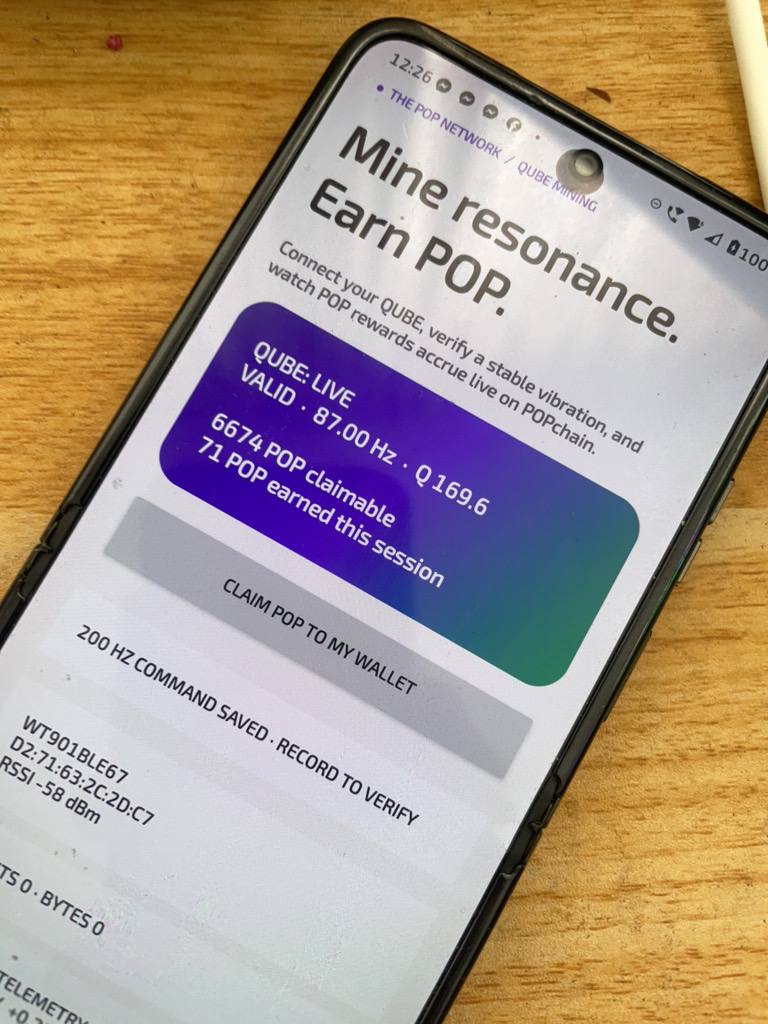
That was the first thrilling moment: VALID staying on the screen. The Q readings moved a little—as real measurements should—but held together. Then the full loop came alive. The QUBE was registered to my POP identity, paired through fresh physical telemetry, challenged by WARDEN, and accepted by POPchain. A verified observation began earning POP. The rewards were no longer a mock counter or a promise waiting behind another interface; they were accruing against the registered QUBE and could be claimed to its owner wallet.
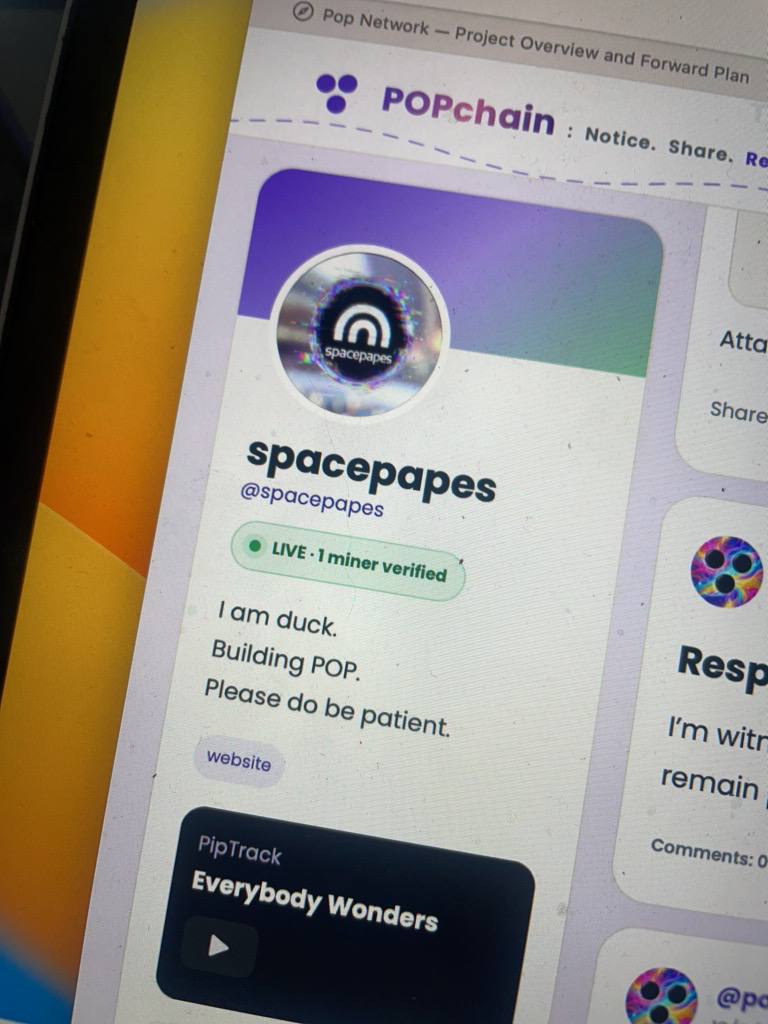
The same live state then appeared elsewhere in the network. Popfeed gained a small green badge beneath my handle: LIVE · 1 miner verified. That detail means more to me than its size suggests. The physical vibration on the desk had travelled through the QUBE, the phone, WARDEN and POPchain, and returned as public presence on my profile.
We also solved an important practical problem: mining cannot depend on somebody staring at their phone. QUBE reporting now runs through an Android foreground service with an ongoing live notification, so the screen can lock while the BLE connection, analysis and verified reporting continue. The phone is the QUBE’s current bridge into the network, but it no longer has to behave like an illuminated shrine.
Once the machinery worked, the app needed to feel like the world it belonged to.
The QUBE utility has now become POP Hub. It opens directly onto mining, with the canonical POPmark slowly rotating and breathing in a field of violet, mint, pink and blue light. Live frequency, Q, WARDEN state, claimable POP and session rewards sit at the centre. Detailed six-axis telemetry and capture tools are still there, but folded away until they are needed. The original phone sensor recorder remains available too.
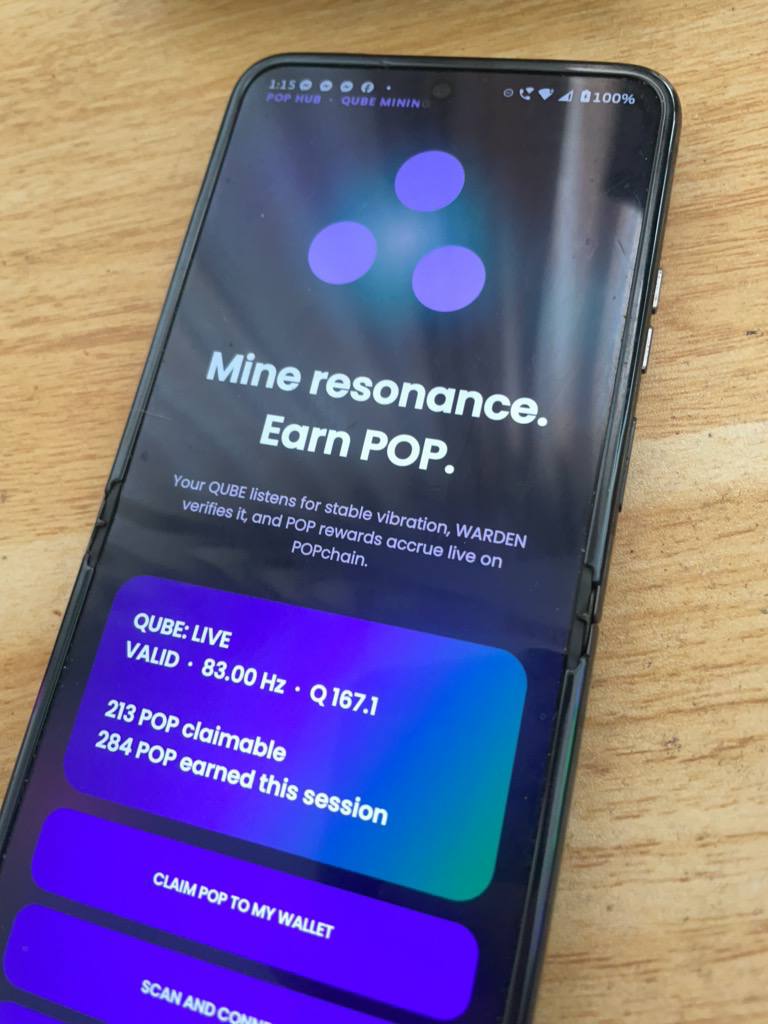
POP Hub is deliberately a beginning. Mining is its first native room. The structure now has space for the chain explorer, Profile, Popfeed and chat to join it later, until the hub can simply become the POP app.
There is plenty left to refine. QUBE still has to meet more surfaces, more kinds of machines, more phones and more ordinary environments. The policy will need to learn from honest field data without turning every placement into an ordeal. But the essential shape is real now: attach the QUBE to something that hums, let it listen, let WARDEN verify the stability, and let that physical resonance become visible activity on POPchain.
For a long time, Proof of Resonance was a system I could describe.
Now there is a little sensor blue-tacked to a Bitaxe, a POPmark turning on my phone, a green miner badge beneath my name, and POP arriving because something in the room is genuinely vibrating.
The QUBE started mining.